Shawn Van DaeleShawn Van Daele
Ways of working

How I use AI to improve efficiency, creativity and momentum

The short version: an experienced creative leader who has been handed a very powerful new box of toys. Twenty-five years of judgment, taste and standards came first. The tools make me faster, braver and considerably harder to out-produce.

AI is leverage, not an identity. It does not decide what is worth making, what is true, or what is good. It removes the drag between an idea and something real enough to react to, which is where most creative work quietly dies.

The clearest proof is the page you are on. This entire site is a solo build, accelerated by the workflow described below.

The new box of toys. The hands using it are the same ones as ever.
The workflow

What this looks like on a real project

Six stages. The tools show up in the first five. The last one is the reason the work is worth anything.

  1. Interrogate the problem

    Before anything gets made I use AI the way I would use a very fast research assistant: pressure-testing the brief, mapping what an audience already believes, pulling apart competitor language, and arguing with my own first instinct until it holds up.

    I decide what the real problem is. The tool just gets me to a defensible answer faster.

  2. Draft, version, and stress-test the words

    Positioning lines, campaign platforms, executive letters, cases for support. I write the spine myself, then generate variants for different audiences and read them back against the strategy. Weak writing gets exposed much earlier this way.

    Voice is mine. If a sentence does not sound like a person, it does not ship.

  3. Explore visually before committing budget

    Image and video generation is a direction tool. I can show a client three legitimate visual worlds in an afternoon instead of describing them, which means the expensive production decisions get made with something real on the table.

    Generated frames are moodboards and previews. Final client art is photographed, designed or shot.

  4. Automate the mechanical middle

    Resizing, tagging, transcribing, syncing, formatting, QA passes, metadata, publishing. The unglamorous volume work that quietly eats a creative team's week now runs on a schedule instead of a person.

    I design the system and set the standard it has to meet.

  5. Build the thing instead of describing it

    When an idea needs to be felt, I build a working prototype in code rather than a slide about it. This site is the clearest example: a live product, not a mockup.

    Prototypes are how I de-risk an idea before anyone commits a budget to it.

  6. Finish it by hand

    Typography, pacing, edit points, colour, the last ten percent that separates competent from memorable. That part has never been automatable and I would not want it to be.

    Final creative authority sits with me, every time.

Proof

Three things this made possible

Case study one

This website, which rewrites itself for whoever opens it

The site you are reading is the portfolio piece. Designed, written, art directed and built solo, with AI as the production crew.

A career this wide is a liability on a conventional portfolio. A marketing director, a fundraising executive and a creative recruiter each need a different version of the same truth, and none of them will dig for it. So I built a site that reads the visitor's context and reorders itself around the role they are hiring for.

See how the tailoring works
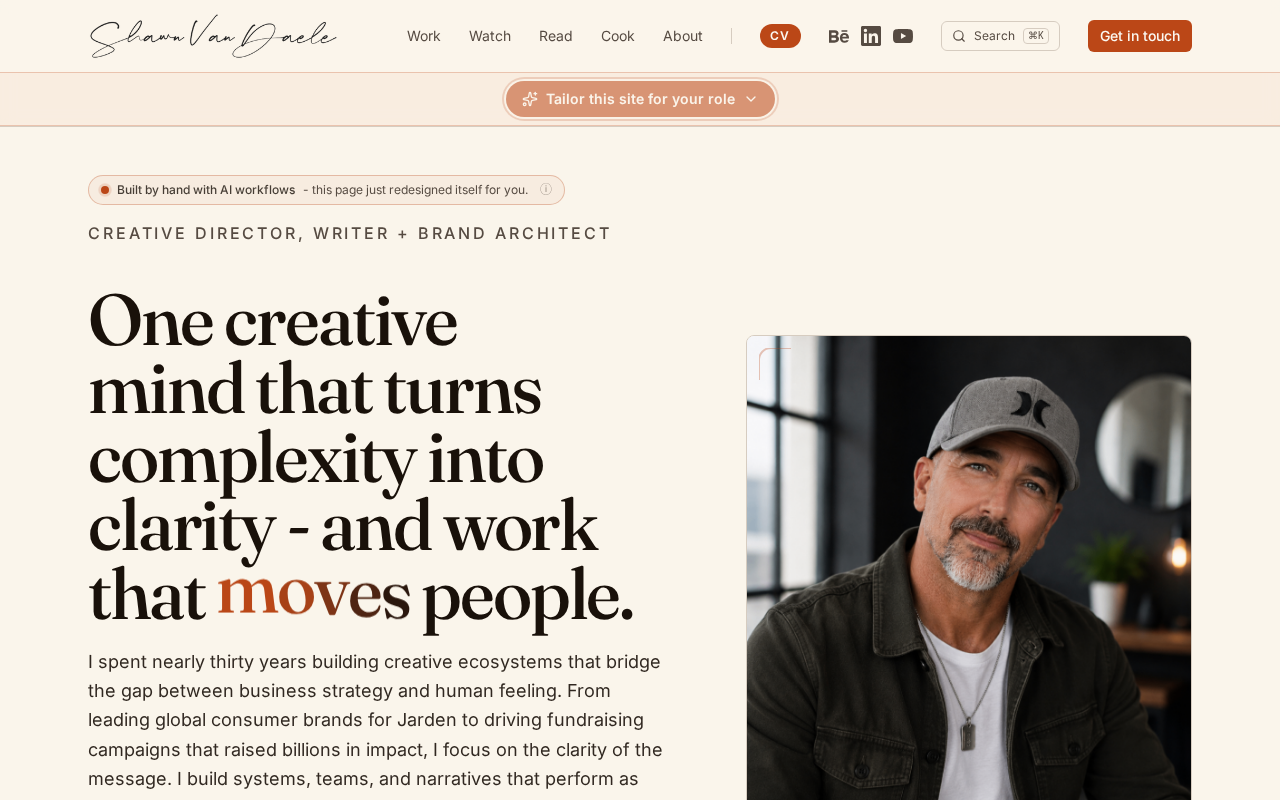
The live homepage of shawnvandaele.work, which reorders itself around each visitor's role
The live site, rewriting itself around the visitor's role
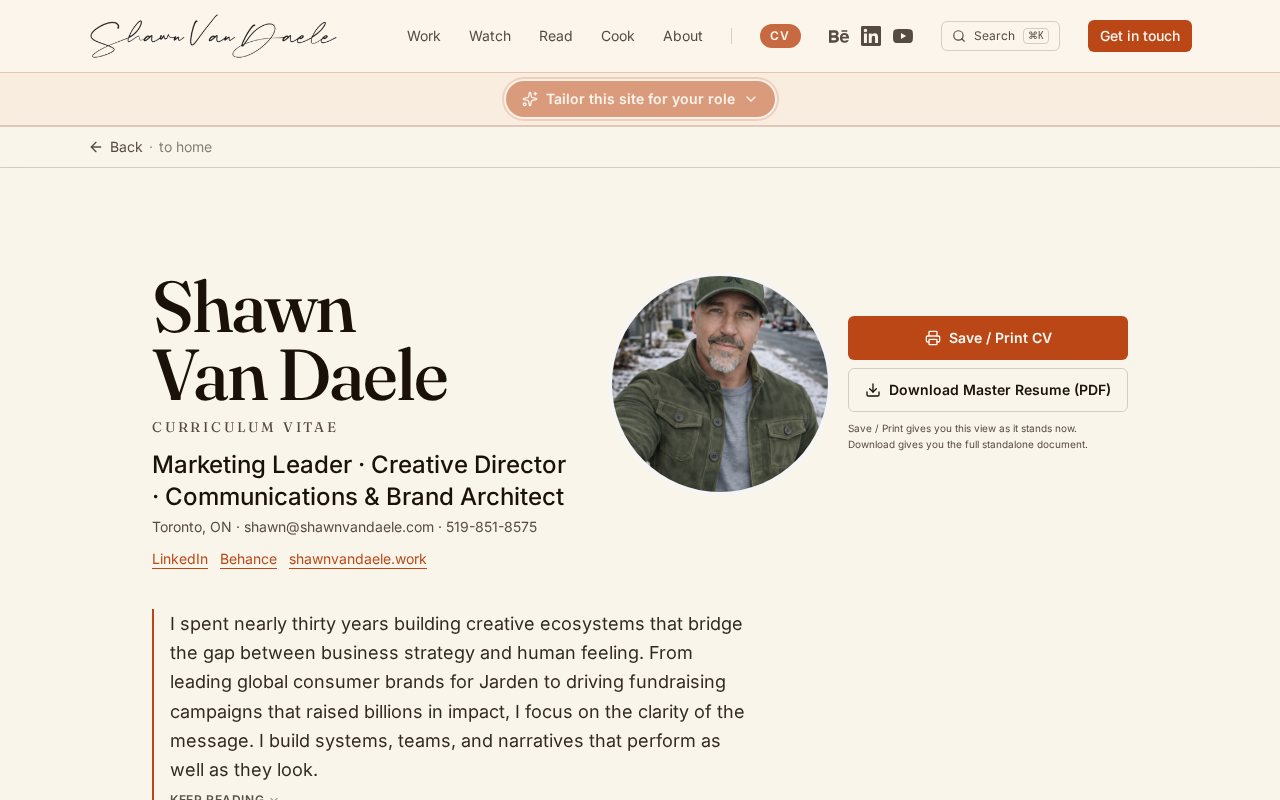
The focus-aware CV view on the live site
The CV, tailored and printable from the same engine
What got built
  • An adaptive engine that reweights the headline, bio, capabilities, roles and case studies for nine different hiring lenses
  • Tailored URLs so a recruiter or a hiring manager can be sent straight into the version of the site built for their role
  • A focus-aware CV that prints to a clean three-page document from whatever view you are looking at
  • Owner tooling I use daily: publish and hide switches, priority grading, crop and focal-point editors, thumbnail generation, curation boards
  • A full search layer, sitemap, structured data and social previews across every section
Where the leverage came from
  • AI wrote alongside me, generated placeholder and concept imagery, drafted and refactored code, and handled the repetitive plumbing between systems. That is what made a solo build of this scope possible at all.
Where the judgment came from
  • Every editorial decision, every claim, every layout, every piece of the voice is mine. The engine reorders evidence. It never invents it.
Tools leveraged
  • ChatGPT
  • Claude
  • Lovable
  • TypeScript + React
  • Midjourney
  • Adobe Creative Cloud
  • Figma
Case study two

A living recipe publication, run like a newsroom

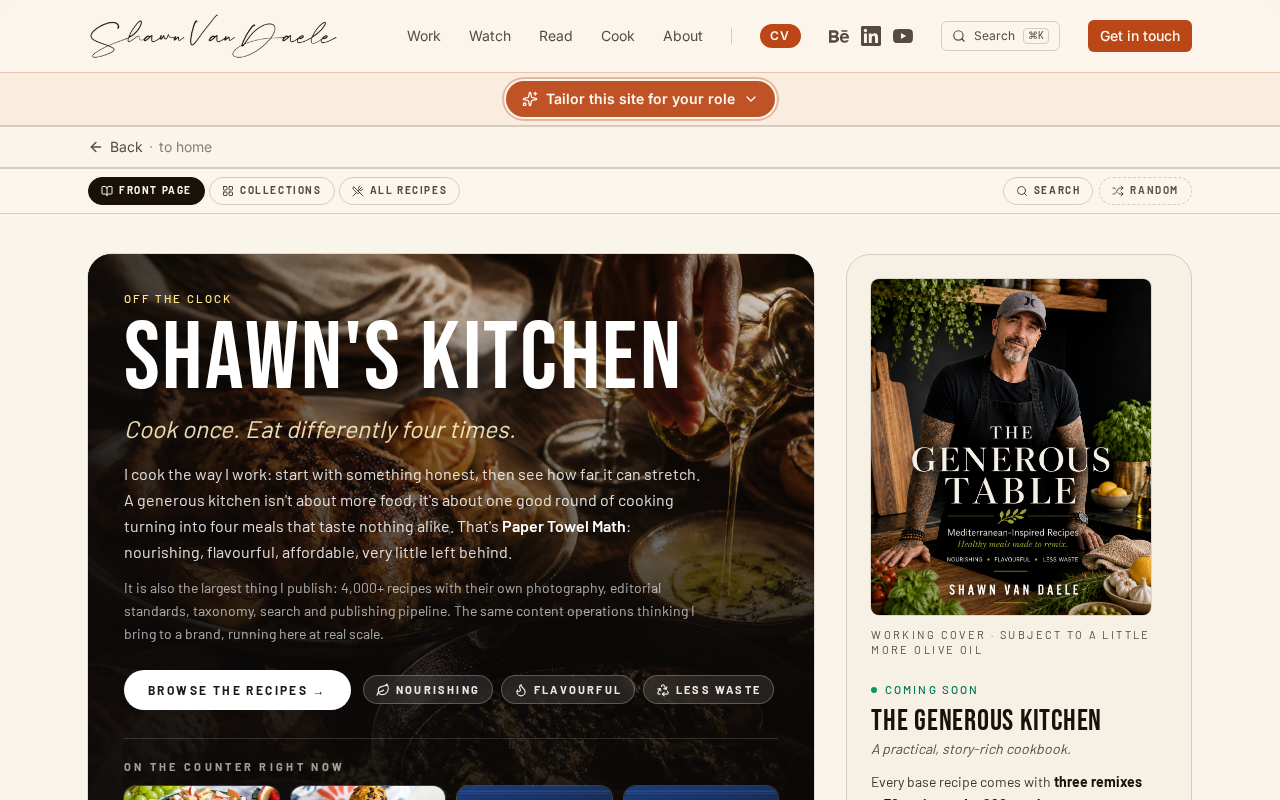
The Kitchen section is a real publishing operation: thousands of published recipes with their own photography, nutrition, taxonomy, search and editorial standards.

I had a personal recipe archive that had grown past four thousand entries in a spreadsheet. Useless as a spreadsheet, and far too large to publish by hand. I wanted it to become a genuine food publication without hiring a team to get it there.

Walk through the Kitchen
The Kitchen section: a searchable food publication with thousands of recipes
The Kitchen, run like a newsroom
Sunday sugo, photographed for the recipe librarySkillet cookie, photographed for the recipe libraryBackyard bird, photographed for the recipe library

Every dish carries its own photography, generated to match the recipe and held to one publishing rule: no image, no publish.

What got built
  • An automated pipeline that reads the master index, detects new and changed entries, and queues them for publication without duplicating anything
  • Generated food photography for every recipe, matched to the dish rather than dropped in as stock
  • Nutrition, remix ideas and editorial collections produced at scale, then held to a publishing rule: nothing goes live without an image
  • A searchable, filterable library with collections, saved recipes, newsletter delivery and a magazine-style article page for every dish
Where the leverage came from
  • Scheduled jobs handle the ingest, the imagery and the metadata. A human being could not have photographed and formatted thousands of recipes; a designed system can.
Where the judgment came from
  • I set the editorial standard, the taxonomy, the photographic look and the rule about what is allowed to publish. The pipeline enforces my standard, it does not replace it.
Tools leveraged
  • ChatGPT
  • Scheduled sync jobs
  • AI image generation
  • Google Sheets master index
  • Adobe Creative Cloud
Case study three

A film world, scripted by hand and built ten seconds at a time

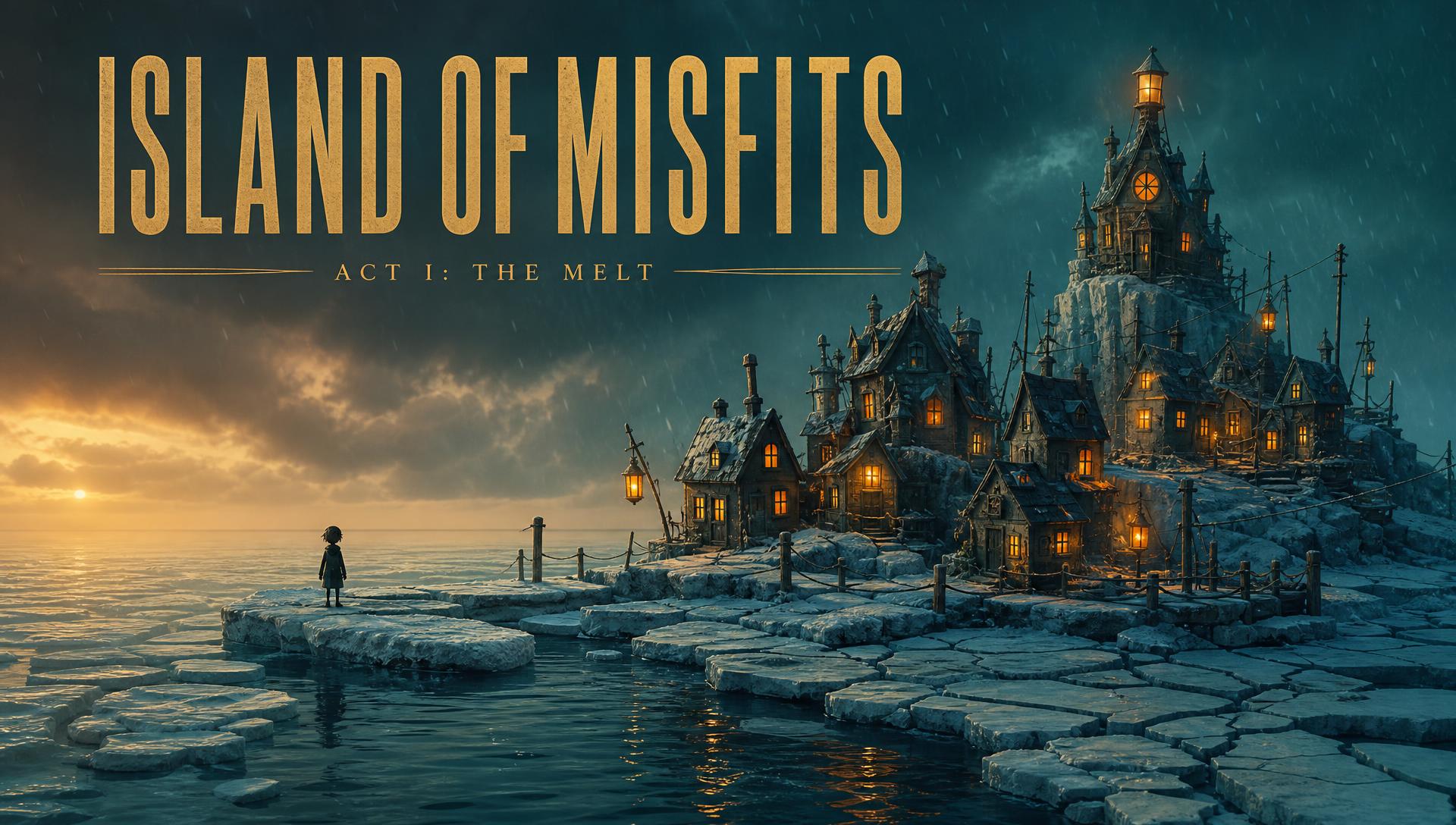
The Island of Misfits is a world of original characters and songs that I scripted and conceptualized myself, then modernized with AI: each film is generated roughly ten seconds at a time, with the characters designed and their movement directed shot by shot.

A character world with songs and short films is normally a studio-scale project: weeks of design, shooting and scoring for each film. I wanted one person's output to sit closer to a studio schedule, without giving up the writing, the characters or the original music that make the world worth visiting.

Visit the Island of Misfits
The Island of Misfits: characters designed and directed by Shawn, generated ten seconds at a time
Characters and world designed and directed, built ten seconds at a time
What got built
  • Scripts, story and concept for every act, written and developed by me before a single frame is generated
  • Character design and shot-by-shot creative and movement direction, generated in passes of about ten seconds and assembled into scenes under one art direction
  • Songs written and produced for each act, with Suno supporting the music beds
  • An act-by-act templating system: character worlds, shot conventions and audio treatment documented once, so the next film is a production schedule instead of a rebuild
  • Every cut, sound design pass and colour finish lands in Premiere Pro, finished by hand
Where the leverage came from
  • AI is the production crew: it renders the shots I design and direct, a short generation at a time, and supports the music beds. The real deliverable is the pipeline, which turns three films into a repeatable series instead of three one-offs.
Where the judgment came from
  • The scripts, the songs, the characters and the edit are all mine. The tools fill in volume. What a film means, and whether a shot is good enough, never leaves my desk.
Tools leveraged
  • ChatGPT
  • Suno
  • Google Flow
  • Adobe Premiere Pro
  • Adobe Photoshop
The stack

Grouped by what it is for, not by logo

Tools change constantly. What matters is knowing which job each one is genuinely good at, and being willing to drop it when something better shows up.

See every tool and the projects it shows up in

Thinking and writing

Research, interrogation, drafting, versioning and editorial pressure-testing.

  • ChatGPT
  • Claude
  • Google Gemini
  • Microsoft Copilot
  • Perplexity

Image and video direction

Concept exploration, moodboarding and previsualization before production spend.

  • Midjourney
  • Adobe Firefly
  • Nano Banana
  • Google Flow
  • Google Veo
  • Runway
  • Sora

Sound and voice

Scratch tracks, narration passes, music exploration and edit-room cleanup.

  • ElevenLabs
  • Suno
  • Descript
  • Adobe Audition

Build and automation

Working prototypes, live products, scheduled jobs and publishing pipelines.

  • Lovable
  • TypeScript + React
  • GitHub
  • Supabase
  • Cloudflare
  • Vercel
  • Framer
  • Webflow
  • Scheduled sync jobs
  • Structured content models

Craft, unchanged

Where the final work is actually finished, same as it has been for 25 years.

  • Adobe Creative Cloud
  • Figma
  • Premiere Pro + After Effects
  • DaVinci Resolve
  • Photography
Standards

Where I draw the line

No invented facts

No fabricated metrics, quotes, testimonials or outcomes, on this site or in client work. If a number cannot be sourced, it does not appear.

Generated imagery is exploration

It earns its place in concepting, previsualization and internal work. Final client-facing art is photographed, designed or produced, where possible.

The voice stays human

An executive letter, a case for support or a brand line has to sound like a person with a point of view. I write those, then use tools to sharpen them.

Disclosure, not decoration

Where AI shaped a piece of work, I say so plainly, and I label what was AI-assisted rather than quietly passing it off as something else.

Judgment is never delegated

Final creative authority, the standard for what ships and accountability for the result sit with me. That is the job.

If you want a team that moves like this, that is the part I can bring with me.

The craft is the same craft. The pace is not. Happy to walk through any of it in detail, including the parts that did not work.